

WHAT IF WE NEVER EVOLVED FORWARD?
What If We've Only Been Remembering Backwards?

There is a peculiar feeling that arrives sometimes before thought does.
A feeling so small most people dismiss it before it fully forms.
You hear a drum for the first time and your body somehow already knows where the rhythm lives.
You enter the ocean and after the initial panic something ancient in your spine relaxes, as though the body recognizes a conversation older than language.
A child whistles back at a bird without understanding why.
A hand touches clay and immediately begins shaping.
Not learning.
Remembering.
Or at least that is what it feels like.
And feelings, while not always scientifically correct, are often philosophically important.
So let us begin with a question no one asked properly in school:
If evolution is true if life moved from ocean to land, from cell to nervous system, from primate to poet
Then why does so much of human life feel less like invention and more like recovery?
Why does progress so often resemble return?
Not forward.
Back.
“Perhaps the deepest human longing is not for the future, but for reunion with something we cannot fully name.”
THE CELL THAT BECAME A CHOIR
Every credible account of evolution begins in almost unbearable simplicity.
A cell.
Not consciousness.
Not civilization.
Not a soul staring at the stars asking metaphysical questions.
Just chemistry wrapped in membrane.
And yet inside that membrane something extraordinary emerged:
Self-maintenance.
Life learned in the most primitive sense possible how to continue.
Then came one of evolution’s greatest revolutions:
Cooperation.
Single cells merged into more complex structures. Organelles once thought to be independent organisms became permanent residents inside larger cells. Eventually, multicellular life emerged tissues specializing, sacrificing autonomy for collective survival.
The body was born from negotiated relationship.
Not domination.
Coordination.
And from there, sensation unfolded:
nervous systems,
memory,
anticipation,
pain,
attraction,
orientation toward and away from.
Then eventually:
a strange animal appeared.
One that could not outrun predators.
Could not fly.
Could not echolocate.
Could not regenerate limbs.
Could not survive underwater.
Could not smell like a wolf or navigate like a migrating bird.
And this creature
fragile, anxious, under-equipped
started building tools.
“The body survived by becoming collective long before civilization ever did.”
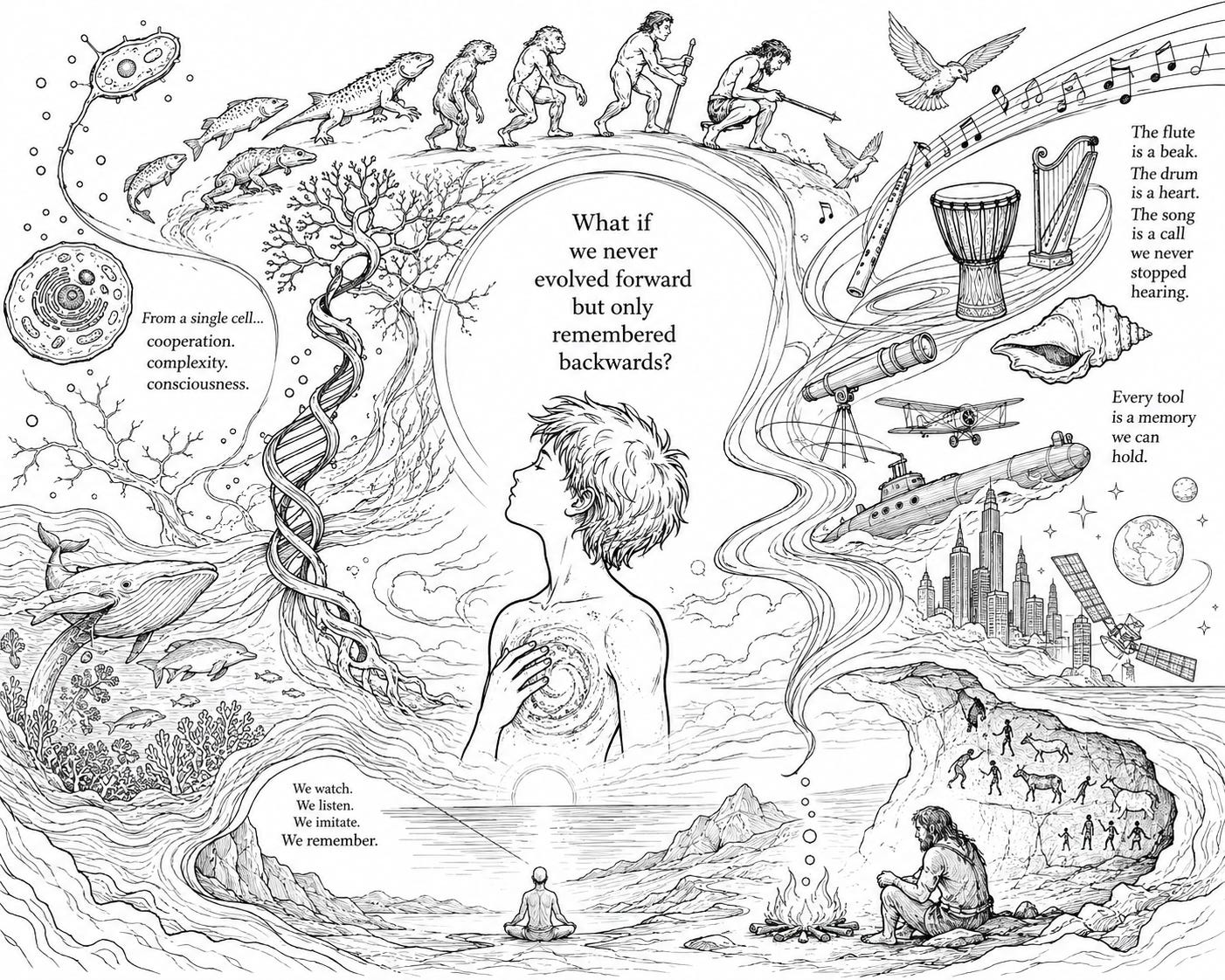
TOOLS ARE MEMORY WE CAN HOLD
At first glance, technology appears to be humanity escaping biology.
But look closer.
Many of our inventions resemble biological capacities translated into external form.
The telescope extends vision.
The microphone extends hearing.
The airplane imitates flight.
The submarine imitates aquatic adaptation.
The spear extends the reach of the arm.
Even musical instruments often echo structures already present in nature.
The drum resembles heartbeat and footfall.
The flute transforms breath into birdsong.
String instruments vibrate like tensioned webs responding to contact.
Of course, none of this proves mystical ancestral memory.
Convergent design can emerge naturally because physics constrains what forms are efficient. Wings evolved independently in insects, birds and bats not because they remembered each other, but because aerodynamics rewards certain shapes.
And yet phenomenologically from the inside of human experience invention often feels strangely familiar.
As though the nervous system recognizes something before it understands it intellectually.
Not:
“I created this.”
But:
“I know this somehow.”
Science alone cannot fully interpret that feeling.
But philosophy should not ignore it.
“Every tool may be less a triumph over nature than a negotiation with its forgotten patterns.”
DARWIN, BERGSON AND THE ARGUMENT ABOUT DIRECTION
Charles Darwin gave us the mechanism of evolution:
variation, selection, inheritance.
Importantly, Darwinian evolution has no predetermined destination.
Evolution is not climbing a ladder toward perfection.
It is adaptation to local conditions.
A shark is not “less evolved” than a human.
Bacteria are not primitive failures.
Natural selection rewards fitness, not enlightenment.
This matters because many romantic interpretations of evolution quietly smuggle purpose back into biology.
And yet philosophers like Henri Bergson sensed that something about lived experience resisted pure mechanistic description.
In Creative Evolution, Bergson proposed the élan vital a creative impulse moving through life.
Modern biology largely rejects this as a scientific explanation.
And rightly so.
There is no empirical evidence for a mystical force directing evolution toward higher consciousness.
But Bergson’s deeper intuition may still matter philosophically:
From inside consciousness, life does not feel random.
It feels participatory.
Meaning-seeking.
Directional in experience even if not in mechanism.
This distinction is crucial.
Scientific evolution explains how complexity emerges.
It does not fully explain why consciousness experiences existence as longing.
Arthur Koestler made a related argument in The Ghost in the Machine — that the human brain is not a clean upgrade but a layered architecture, each new region built atop older ones, the ancient mammalian structures still running beneath the rational cortex like software that was never fully uninstalled. We carry our evolutionary past inside us. Literally. In the architecture of the skull.
You are not a modern mind. You are a geological formation.
And Peter Sloterdijk, in his anthropology of the human as a practicing animal, argued that most of what we call culture sport, music, ritual, craft, warfare is not progress beyond biology but a continuous rehearsal of biological capacities through new media.
We practice being alive. Because something in us suspects we have forgotten how.
“Evolution may not have a destination yet consciousness keeps behaving as though it misses one.”
THE ANIMALS WE KEEP BORROWING FROM
Human beings are extraordinary imitators.
We learned flight partly through studying birds.
Sonar through studying bats.
Hydrodynamics through fish and marine mammals.
Indigenous navigation systems often emerged through generations of embodied observation:
reading currents,
wind patterns,
stars,
bird migration,
wave memory.
Nature was humanity’s first laboratory.
Still is.
And perhaps this reframes the question entirely.
Maybe technology is not evidence of superiority over nature.
Maybe it is apprenticeship.
A species learning through attention.
This also guards against human exceptionalism.
Tool use is not uniquely human:
crows shape hooks,
octopuses carry shelter,
chimpanzees construct probing tools,
dolphins teach hunting techniques culturally.
Intelligence externalizes itself across many species.
Humans simply expanded the scale.
Which means the deeper question is not:
“What did humans lose?”
But:
“Why does intelligence everywhere seem driven to extend itself beyond the body?”
“Perhaps consciousness does not want to remain trapped inside flesh alone.”
WHAT THE MYSTICS SUSPECTED
Long before neuroscience or evolutionary theory, contemplative traditions repeatedly described reality as participation rather than separation.
In Sufi mysticism, the human being was often described as forgetful rather than empty a creature whose deepest task was remembrance.
In Plato’s philosophy, learning itself was framed as recollection:
the soul recognizing truths it somehow already knew.
In Hindu traditions, consciousness was not produced by the individual organism alone, but understood as part of a larger field of awareness temporarily localized into form.
These are not scientific claims.
They are metaphysical intuitions.
And they become dangerous when treated as empirical substitutes for biology or neuroscience.
But as phenomenological descriptions of human experience?
They remain startlingly relevant.
Because many people genuinely experience beauty, rhythm, ritual, music, or meditation not as acquisition
but as return.
“The mystics did not believe humanity was empty. They believed humanity was forgetful.”
SYNESTHESIA AND THE LEAKING OF THE SENSES
One of the strangest windows into this discussion comes from synesthesia:
a neurological phenomenon in which sensory boundaries blur.
Some people hear colors.
Taste sounds.
See shapes attached to numbers or words.
Neuroscience explains this through atypical cross-activation between sensory regions of the brain.
But phenomenologically, synesthesia reveals something profound:
The senses are less separate than we assume.
Perception itself is already translation.
Already metaphor.
Already integration.
Perhaps this is why music can feel blue.
Why grief feels heavy.
Why certain memories carry texture.
The brain does not experience reality in isolated channels.
It weaves.
And maybe human creativity emerges precisely from this weaving:
the nervous system continuously translating one mode of existence into another.
Sound into movement.
Emotion into image.
Memory into architecture.
Longing into technology.
“The mind may create because reality itself arrives already braided together.”
THE SKEPTIC MUST REMAIN IN THE ROOM
An honest philosophy must survive its own criticism.
So let us say clearly what this article is not claiming.
It is not claiming:
humans once had wings,
instruments are literal ancestral memories,
evolution secretly moves toward spiritual perfection,
or ancient mysticism replaces scientific explanation.
Those ideas collapse under scrutiny.
The stronger possibility is subtler.
Human beings evolved nervous systems capable of:
pattern recognition,
imitation,
symbolic thought,
emotional projection,
embodied resonance.
And those systems often experience learning as recognition because cognition itself is built from prior structures.
The swimmer feels the water “remembered” because the nervous system evolved through millions of years of organism-environment interaction.
The musician feels rhythm instinctively because bodies already contain rhythm:
heartbeat,
breath,
gait,
pulse.
No mysticism required.
But no reductionism required either.
Because even if science explains the mechanism,
the feeling remains astonishing.
“Explanation does not cancel wonder. Sometimes it deepens it.”
WHAT REMAINS AFTER EVERYTHING IS QUESTIONED
After skepticism has done its necessary work
after romanticism is corrected,
after metaphysics is restrained,
after biology clarifies what it can
something still remains.
A strange familiarity between the organism and the world.
The sense that certain experiences do not feel imported into us,
but awakened from within us.
Maybe this is cultural inheritance.
Maybe embodied evolution.
Maybe predictive processing.
Maybe physics shaping all possible forms into recurring patterns.
Or maybe consciousness itself is more relational than isolated
less a thing trapped inside the skull than a continuous negotiation between organism and environment.
Whatever the answer,
the feeling persists.
A child hears birdsong and answers.
A hand touches rhythm and follows.
A human being enters water and remembers how not to fight it.
And somewhere between science and metaphor,
between adaptation and longing,
between invention and recognition
the question remains open.
What if evolution did not only move us forward?
What if part of being human is continuously trying to remember how to belong to a world we were never actually separate from?
What is the thing you did for the first time that felt like remembering?
I am genuinely asking. The comments are the continuation of this.
© [Easy Weezy] 2026 |A Journal Of A Curious Mind
“If you find such topics interesting and enjoy reading my post, feel free to support my work by buying me coffee or upgrading to paid subscription thank you for your support, bye for now”
I liked the moments where the text stopped explaining and just stayed near the feeling itself.
That sense that sometimes we don’t really “learn” certain things, we recognize them somewhere deeper first.
The part about rhythm and the body especially stayed with me.
Maybe evolution didn’t make us more human only more distracted from what being human originally felt like. We learned how to move faster consume more and think endlessly yet somehow became strangers to stillness, silence and even ourselves. Sometimes I wonder… if progress keeps removing the very things that once made life feel real, is it still evolution or just a more sophisticated form of emptiness ?