

THE FIELD BETWEEN US
On Whether Healing Was Ever Really a Solo Act

There is a particular kind of silence that precedes a storm.
Not the loud, dramatic silence of a held breath.
The quiet kind.
The kind where everything that was meant to move stopped.
And something else stepped in to fill the gap.
The last chapter ended with a body finding its way home.
A hand touching a wall.
A breath the body chose on its own.
The self locating its edges not through thought, but through sensation.
We called it the return.
But here is the question nobody asked afterward:
Return to what, exactly?
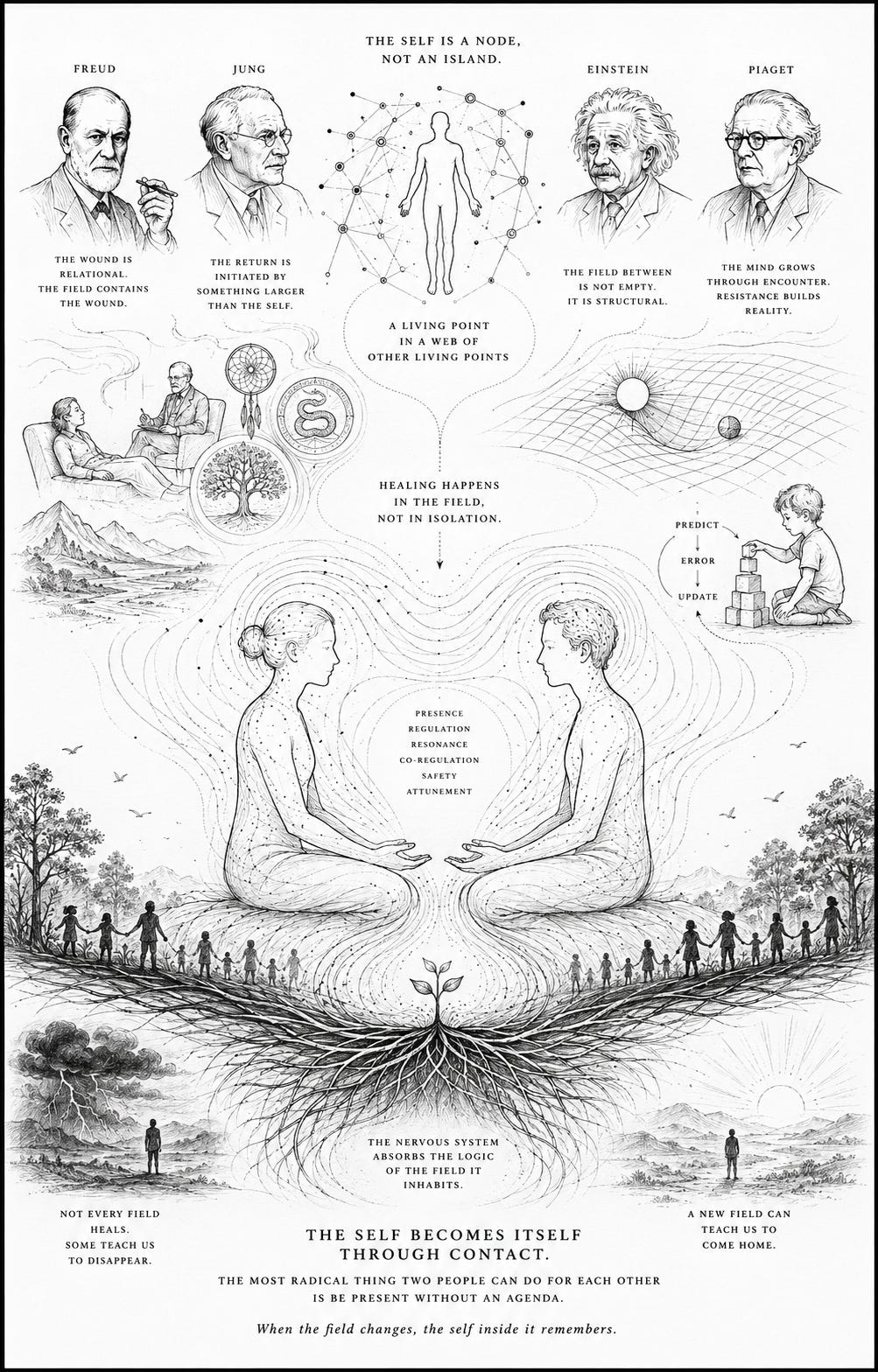
Because if the body is not a sealed container not a sovereign island drifting through empty space but a living node in a web of other living nodes, then healing cannot simply be a private event.
It requires a field.
Not an audience.
A participant.
And perhaps this is the deeper thing civilization keeps forgetting:
No nervous system becomes human alone.
WHAT FREUD ALMOST SAID
Sigmund Freud spent his career insisting that the wound is personal.
Born in the interior.
Stored in the unconscious.
Expressed through symptom.
And to Freud’s immense credit, he understood something most modern culture still avoids:
The self is not transparent to itself.
Something older than conscious thought lives underneath language, shaping action before explanation arrives.
But Freud stopped one step too early.
Because what he observed in transference that strange moment when the patient begins to feel toward the analyst (Therapist) what they once felt toward a parent, lover or wound was not a distortion of therapy.
It was the therapy.
The nervous system was doing what nervous systems always do:
Searching the present for the shape of the past.
Testing whether this new relational field is safe enough to update the old prediction.
Freud saw the mechanism.
But he still framed healing as something occurring primarily inside the individual psyche.
As though the relationship were merely a mirror.
Not realizing the field itself was changing the patient in real time.
The field was always the medicine.
He simply kept trying to describe it from outside the room.
WHAT JUNG HEARD IN THE SILENCE
Carl Jung went further and stranger.
Where Freud trusted the personal unconscious, Jung trusted something larger:
A layer of shared symbolic reality beneath the individual mind itself.
He called it the collective unconscious.
Archetypes.
Dreams.
Myths appearing across cultures separated by oceans and centuries.
Science has often treated this as mysticism dressed in psychology.
But Jung was pointing toward something profound:
That the psyche may not end at the skin.
And neither does healing.
What fascinated Jung was not merely what emerged from within people
but what answered them from outside.
A dream mirrored by reality.
A symbol appearing simultaneously in inner life and outer life.
A coincidence carrying impossible emotional weight.
He called this synchronicity.
Not causation.
Connection.
Modern language might call it pattern-recognition amplified by emotion and salience.
But phenomenologically, Jung was describing something deeper:
A self that becomes coherent through resonance with the world around it.
Not isolation.
Participation.
And this idea is far older than Jung.
THE OLDER MEMORY HUMANITY KEEPS RETURNING TO
Long before psychology existed, cultures across the world described reality as relational at its core.
In many Indigenous traditions, the individual was never understood as separate from land, ancestor, tribe, ritual or cosmos. To exist was to participate.
In Buddhism, suffering emerges through the illusion of separateness the mistaken belief that the self exists independently from the web of causes and conditions surrounding it.
In Sufism, the deepest spiritual realization was not individual mastery, but dissolution into relationship the self becoming porous enough to experience unity directly.
In Hermetic traditions, the phrase was simple:
“As above, so below.”
Meaning:
the structure repeats.
Mind within body.
Body within society.
Society within cosmos.
Different scales.
Same pattern.
The modern world hears these as metaphors because it has forgotten how ancient systems spoke:
Not analytically.
Structurally.
They were not claiming the universe was literally human.
They were observing that reality appears organized through relationship at every visible scale.
And strangely enough
modern science keeps rediscovering versions of the same intuition.
WHAT EINSTEIN KNEW ABOUT FIELDS
In 1915, Albert Einstein published the field equations of general relativity.
The insight was revolutionary:
Gravity is not a force pulling objects together across empty space.
It is curvature within a shared field.
The sun bends spacetime.
The earth follows the curve.
Remove one object, and the entire system changes.
Now to be precise:
Psychological fields are not literally gravitational fields.
But the relational structure is strikingly similar.
Across scales, systems do not exist independently.
They co-regulate.
Two people entering a room alter the emotional geometry of that room immediately:
breath rhythm
posture
facial microexpressions
autonomic tone
mirror neuron activity
The space between people is not empty, it is information.
And once you realize that, the boundary between “self” and “environment” becomes far less obvious than we were taught.
WHAT PIAGET SAW IN THE PLAYGROUND
Jean Piaget spent years observing children.
Not abstractly.
Directly.
And what he discovered was quietly revolutionary:
A child develops intelligence through collision with reality.
The child reaches.
Reality resists.
The model fails.
The model updates.
Piaget called this accommodation.
The mind becoming more accurate because the world refused to conform to its assumptions.
And here is where the implications become enormous.
A child who never encounters genuine resistance
who is overprotected,
over-managed,
shielded from friction
They develop a prediction machine that has never been adequately corrected.
A mind that has never learned to lose an argument with reality.
Untested.
Unable to revise itself through encounter.
Sound familiar?
The same pattern appears again in predictive processing models explored by Karl Friston and others:
The mind becomes healthy not through certainty but through corrected error.
Through relationship with something outside itself.
Without that correction?
Predictions harden into worlds.
NOT EVERY FIELD HEALS
But we should pause here.
Because not every relational field heals.
Some deform.
Some regulate through fear.
Some teach the nervous system that visibility is dangerous, that vulnerability invites punishment, that presence itself is unsafe.
A child entering a violent household learns a field too.
A body can synchronize to terror just as easily as safety.
Which means relationship is not automatically medicine.
It is amplification.
The nervous system absorbs the logic of the field it inhabits most consistently.
And this is why healing cannot merely mean “being around people.”
It means entering a field organized differently from the one that produced the wound.
A field where the body no longer has to disappear to survive.
THE FIELD IS THE MEDICINE
And here is where Freud, Jung, Einstein, Piaget, neuroscience and ancient metaphysics quietly converge.
Freud showed that wounds repeat relationally.
Jung showed that meaning emerges collectively.
Einstein showed that systems alter each other through shared fields.
Piaget showed that intelligence develops through encounter.
Different languages.
Same architecture.
The self does not stabilize alone.
Which is why the deepest forms of healing rarely arrive as information.
They arrive as experience.
A choir singing together.
A movement workshop.
A grief ritual.
A friendship where silence feels safe.
A therapist whose nervous system does not panic when yours does.
These experiences do not merely “feel good.”
They reorganize prediction itself.
The body enters a new field.
The nervous system expects danger.
And then slowly, repeatedly, almost unbelievably danger does not arrive.
This is not inspiration.
This is recalibration.
The prediction machine gets usefully wrong.
And then, for perhaps the first time in years, It updates.
THE METAPHYSICAL POSSIBILITY
And now we arrive at the edge of the question science can describe but not fully answer.
If minds regulate each other,
if nervous systems synchronize,
if identity itself stabilizes through participation..
then perhaps consciousness was never fundamentally individual to begin with.
Not because the self is unreal.
But because the self may be relational at its root.
A pattern sustained through contact.
Ancient metaphysics hinted at this constantly.
The mystics described humanity as fragments of a larger mind.
The contemplatives spoke of unity beneath separation.
Even Plato imagined knowledge not as acquisition, but remembrance the soul recognizing what it already belonged to.
Perhaps they were not entirely wrong.
Perhaps consciousness is less like a possession and more like a field phenomenon:
Something that emerges wherever life becomes sufficiently connected to itself.
Cells becoming organs.
Organs becoming bodies.
Bodies becoming societies.
Minds becoming culture.
Layer upon layer of participation.
The modern world calls this metaphor because it fears what follows if it is true:
That no human being has ever truly existed alone.
THE QUESTION THIS CHAPTER LEAVES OPEN
None of this erases individuality.
Freud was right that the interior matters.
Jung was right that larger patterns move through us.
Einstein was right that fields are structural.
Piaget was right that development requires encounter.
But what they were circling across different centuries, disciplines and vocabularies was the same possibility:
The mind is neither fully private nor fully social.
It is relational.
A self becomes itself through contact.
And perhaps The most radical thing two people can do for each other is be present without an agenda.
To remain present long enough for the nervous system to remember that reality can be shared safely again.
Because when the field changes
the self inside it changes too.
Quietly, Gradually. Without spectacle.
Like a body remembering how to come home.
The next chapter asks: if healing is relational and the field is the medium; what does it mean that most of us are living in fields that are chronically dysregulated? And what would it take to build environments that heal rather than environments that merely contain?
STAY TUNED FOR THE NEXT EPISODE 🙏🏿
P.S. This chapter stands on top of several others.
The body as the first mind.
Psychosis as a disruption of grounding.
Consciousness as participation rather than isolation.
If this piece resonated with you, the deeper architecture behind it lives in the earlier chapters for paid subscribers.
© [Easy Weezy] 2026 |A Journal Of A Curious Mind
“If you find such topics interesting and enjoy reading my post, feel free to support my work by buying me coffee or upgrading to paid subscription thank you for your support, bye for now”
The dream world is more real than the relational world according to many old cultures . All of our sciences grew out of some sort of faith/religious system. Several new forms of religion/faith were established after August, 1945. Eighty years since then, the world is changing once again.
I loved the way you connected the concepts of historical minds and built a chronological structure for a powerful argument. Just one part is missing- the biological aspect of the human experience. Specifically, the fact that the nervous system is biological in nature as well. The nervous system is not simply the mind, but the body as well. Many specific medical conditions, such as Ehlers Danlos syndrome, involve dysregulation of the body’s nervous system. This stems from dysautonomia - when the body stops correctly regulating things like heart rate and blood pressure for example. The sympathetic nervous system says “there is danger”, then the parasympathetic nervous system is supposed to turn on to calm the body back down. Dysregulation of this “system” can be strictly medical in nature, without any reference to the psyche, the collective consciousness, or learned behavior. Just a thought to add to your exploration of the full scope of human experience. Enjoyed the article!☺️